Public Online Masterclass: Is my patient ‘dissociative’, ‘borderline’, ‘psychotic’, a case of PTSD, or what?
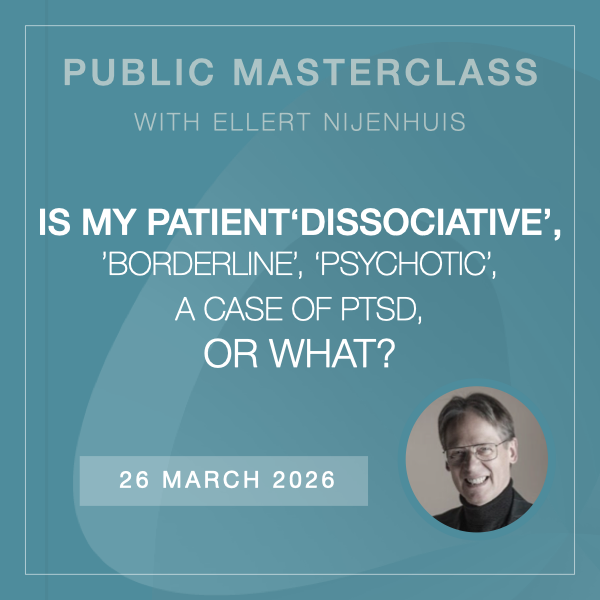
Public Online Masterclass: Is my patient ‘dissociative’, ‘borderline’, ‘psychotic’, a case of PTSD, or what?
Date: Thursday 26 March 2026
Time: 8pm CET, 2pm EST, 11am PST, 7pm GMT
Duration: 90 minutes
Tutor: Ellert Nijenhuis, Ph.D.
Can’t attend live? Ticket holders will receive access to the recording of the public masterclass for 7 days.
Certification of participation: We only provide “Certification of participation” to annual eAcademy members.
————-
IS MY PATIENT ‘DISSOCIATIVE’, ‘BORDERLINE’, ‘PSYCHOTIC’, A CASE OF PTSD, OR WHAT?
What is dissociation and how can we assess it?
Do you sometimes struggle to assess dissociative disorders? For example, you may find it hard to distinguish DID, bipolar mood disorder, and schizophrenia in actual practice. Have you ever felt stuck in getting dissociative parts to cooperate with one another? They can be so opposed. This may make you experience your task as a therapist impossible, overwhelming or emotionally draining.
In this Public Masterclass series, Ellert Nijenhuis starts sharing what he learned while working with dissociative patients for over 40 years. His goal is to help you gain clarity and feel more confident in your therapeutic work with people with DID.
This public masterclass is ideal for:
Psychotherapists, psychiatrists, and other therapy practitioners
Including clinicians working with complex trauma and dissociative disorders.
Educational and psychosocial professionals
Who support children, adolescents, or adults with complex trauma histories.Medical, psychology, and healthcare students
With an interest in trauma, dissociation, and clinical practice. Sign up with your university’s email address and receive access to the second and third masterclass for free.
A personal message from Ellert:
“if we wish to speak about dissociative disorders, we need to have a very clear idea what these disorders are about and how they are different from other disorders such as borderline personality disorder and PTSD. Once in a while I meet colleagues who say, well, dissociative identity disorder is just a complex form of PTSD, or actually it is borderline personality disorder.
And I respectfully disagree with that position for empirical, theoretical and clinical reasons.
A related element in this is that in order to pinpoint what dissociative disorders are about, you need to have a clear understanding of what dissociation is. Every little lack of integration is by some authors referred to as ‘dissociation’. When I switch moods, some people call that dissociation. When I'm absent minded, some people call that dissociation. Why is it such an indistinct container term in psychology these days? It creates major misunderstandings, miscommunications, confusion of tongues things like we studied the correlation between trauma and dissociation. If dissociation is not well defined, you can get all sorts of correlations and don't know what it means.
Then some people respond and say, well, these phenomenas, such as derealization, depersonalization, lowering of the level of consciousness and more, they are correlated, and that idea is an empirical reason why they should be in one box. My simple response is this, I can walk and I can see. Seeing and walking are two things I can do. Many people can and see and walk at the same time. That does not mean that conceptually walking and seeing are the same thing. A high correlation does absolutely not mean conceptual coherence.
So in this Public Masterclass, I address this topic: What is dissociation and how can we assess it?”
About Ellert Nijenhuis
As a -now, retired-psychologist and psychotherapist, Ellert has diagnosed, treated and scientifically studied severely traumatised patients for over 40 years. He developed the Somatoform Dissociation Questionnaire (SDQ-20) and his publications include the book Somatoform Dissociation and the trilogy The Trinity of Trauma: Ignorance, Fragility, and Control. With Onno van der Hart and Kathy Steele he co-authored the book The Haunted Self: Structural Dissociation and the Treatment of Chronic Traumatization.
Nijenhuis has been one of the founders of the ESTD. The International Society for the Study of Trauma and Dissociation granted him several awards, including the Lifetime Achievement Award.
Since 2014, he specifically concentrates on sharing his experience and knowledge regarding the psychology, psychobiology, and treatment of chronic traumatisation and dissociation.