Public Masterclass
Series
In this Public Masterclass series, Ellert Nijenhuis shares what he has learned while working with dissociative patients for over 40 years. His goal is to help you gain clarity and feel more confident in your therapeutic work with people with DID.
For whom:
Psychotherapists, psychiatrists, and other therapy practitioners
Including clinicians working with complex trauma and dissociative disorders.
Educational and psychosocial professionals
Who support children, adolescents, or adults with complex trauma histories.Medical, psychology, and healthcare students
With an interest in trauma, dissociation, and clinical practice.
eAcademy members and “Enactive Trauma Therapy” online course participants can attend these Masterclass free of charge.
Does what I long for count in trauma therapy?
Subtitle: Or must I simply adhere to techniques and protocols?
Do you sometimes struggle to make real clinical progress with trauma patients — even when you’re applying the right techniques and carefully following protocols? Do supervisors ever leave you doubting your own abilities?
Ellert offers a unique perspective on these situations. Attend this Public Masterclass to gain greater clarity and renewed clinical confidence.
Date 11 June 2026
Time: 8pm Berlin/Amsterdam/Brussels time (GMT+1)
Indication of time in different time zones, but please do check yourself: 2pm EST, 12pm PST, 7pm GMT
Cannot attend live? Ticket holders have the opportunity to watch the recording for one week after receiving the video recording link.
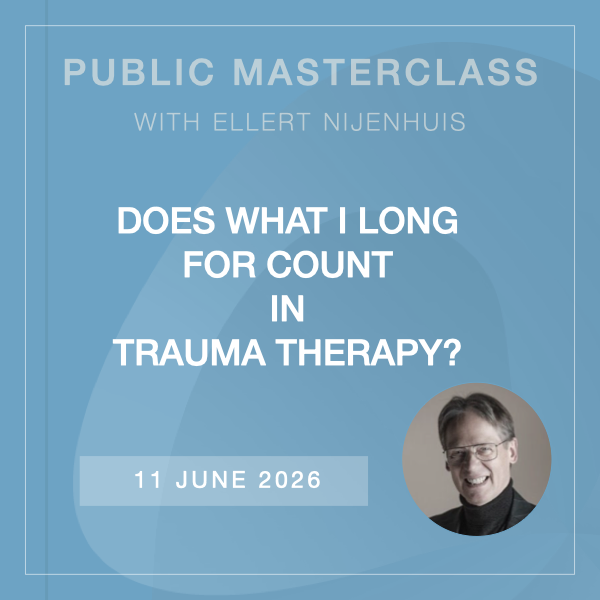
Date: Thursday 11 June 2026
Time: 8pm Berlin/Amsterdam/Brussels time (GMT+1)
Duration: 90 minutes
Tutor: Ellert Nijenhuis, Ph.D.
Can’t attend live? Ticket holders will receive access to the recording of the public masterclass for 7 days. Certification of participation: We only provide “Certification of participation” to annual eAcademy members.
————-
Does what I long for count in trauma therapy? Or must I simply adhere to techniques and protocols?
Do you sometimes struggle to make real clinical progress with trauma patients — even when you’re applying the right techniques and carefully following protocols? Do supervisors ever leave you doubting your own abilities? Ellert offers a unique perspective on these situations. Attend this Public Masterclass to gain greater clarity and renewed clinical confidence.
In this Public Masterclass series, Ellert Nijenhuis starts sharing what he learned while working with dissociative patients for over 40 years. His goal is to help you gain clarity and feel more confident in your therapeutic work with people with DID.
This public masterclass is ideal for:
Psychotherapists, psychiatrists, and other therapy practitioners
Including clinicians working with complex trauma and dissociative disorders.
Educational and psychosocial professionals
Who support children, adolescents, or adults with complex trauma histories.Medical, psychology, and healthcare students
With an interest in trauma, dissociation, and clinical practice. Sign up with your university’s email address and receive access to the second and third masterclass for free.
About Ellert Nijenhuis
As a -now, retired-psychologist and psychotherapist, Ellert has diagnosed, treated and scientifically studied severely traumatised patients for over 40 years. He developed the Somatoform Dissociation Questionnaire (SDQ-20) and his publications include the book Somatoform Dissociation and the trilogy The Trinity of Trauma: Ignorance, Fragility, and Control. With Onno van der Hart and Kathy Steele he co-authored the book The Haunted Self: Structural Dissociation and the Treatment of Chronic Traumatization.
Nijenhuis has been one of the founders of the ESTD. The International Society for the Study of Trauma and Dissociation granted him several awards, including the Lifetime Achievement Award.
Since 2014, he specifically concentrates on sharing his experience and knowledge regarding the psychology, psychobiology, and treatment of chronic traumatisation and dissociation.
Treating dissociation in an environment that denies it
Date 24 September 2026
Time: 8pm Berlin/Amsterdam/Brussels time (GMT+1)
Indication of time in different time zones, but please do double check the time yourself: 2pm EST, 12pm PST, 7pm GMT
Cannot attend live? Ticket holders have the opportunity to watch the recording for one week after receiving the video recording link.

Live online public masterclass by Ellert Nijenhuis
Date: 24 September 2026
Time: 8pm Berlin/Amsterdam/Brussels time (GMT+1)
Indication of time in different time zones, but please do check yourself especially given the change from summer winter time: 2pm EST, 12pm PST, 7pm GMT
Cannot attend live?
Ticket holders have the opportunity to watch the recording for one week after receiving the video recording link.
For whom:
Psychotherapists, psychiatrists, and other therapy practitioners
Including clinicians working with complex trauma and dissociative disorders.
Educational and psychosocial professionals
Who support children, adolescents, or adults with complex trauma histories.Medical, psychology, and healthcare students
With an interest in trauma, dissociation, and clinical practice.
Finding the patient’s next step
Date 22 October 2026
Time: 8pm Berlin/Amsterdam/Brussels time (GMT+1)
Indication of time in different time zones, but please do double check the time yourself: 2pm EST, 12pm PST, 7pm GMT
Cannot attend live? Ticket holders have the opportunity to watch the recording for one week after receiving the video recording link.

Live online public masterclass by Ellert Nijenhuis
Many of us adhere to a phase-oriented approach. We do not necessarily apply ‘symptom reduction and stabilisation’, ‘treatment of traumatic memories’ and ‘rehabilitation’ in a row. We may revisit them if needed, thus build a spiral of growing power to act. Conceiving of therapy as phasic is helpful. But let’s not forget three basic ongoing questions: What is the patient already up to? What is still out of her reach? What next step can she take?
Like every progression, therapy moves from step to step indeed. Learning to walk precedes learning to run. We thus wonder, (1) what actions are required to overcome traumatisation and in what order, (2) what is the patient’s current power to act, and (3) how can we raise this power in a stepwise manner.
In this frame, we and our patients — including all dissociative agents they may include -- co-enact ongoing democracy and transparency. We permanently explore what we long to achieve together. We consider our individual and conjoint power to act relative to these aims. We examine if and how our longings match and can be fulfilled. We strive to engage in mutually doable, rewarding actions, some of which may be new to us. We enjoy and grow by our smaller and larger successes. We regret and correct our smaller and larger failures.
This seminar is for clinicians who wish to become acquainted with a step-wise enactive approach to trauma healing.
Date: 22 October 2026
Time: 8pm Berlin/Amsterdam/Brussels time (GMT+1)
Indication of time in different time zones, but please do check yourself especially given the change from summer winter time: 2pm EST, 12pm PST, 7pm GMT
Cannot attend live?
Ticket holders have the opportunity to watch the recording for one week after receiving the video recording link.
For whom:
Psychotherapists, psychiatrists, and other therapy practitioners
Including clinicians working with complex trauma and dissociative disorders.
Educational and psychosocial professionals
Who support children, adolescents, or adults with complex trauma histories.Medical, psychology, and healthcare students
With an interest in trauma, dissociation, and clinical practice.